
Pocket Watch Movements for Groomsmen Gifts: Mechanical vs Quartz
Mechanical or Quartz Pocket Watch: A Groomsman’s Guide

How the two movements actually differ
Ask a wedding party to pick a pocket watch and most of them will judge the case and the chain first. That’s the wrong place to start. The part that actually decides how the watch behaves for the next twenty years is hidden inside the case: the movement. A mechanical movement is a small machine made of a mainspring, a gear train, and an escapement that ticks the spring’s stored energy out in tiny, regular releases. A quartz movement replaces all of that with a battery, a circuit, and a sliver of quartz crystal that vibrates at a fixed frequency when a current runs through it. One is engineering you can watch happen through a caseback; the other is electronics doing the same job invisibly and, frankly, more precisely.
That single difference in how the watch produces motion is the root of everything else people argue about — accuracy, upkeep, price, and feel. A best man choosing a gift for the groom, or a groom choosing something for his own wedding morning, is really choosing between two different relationships with the object: one where you take part in keeping it running, and one where it just runs.
There’s no universally “better” answer here, and Groom & Co sees both types picked constantly for weddings across Australia. Grooms buying for themselves often lean mechanical because the watch will become a keepsake tied to one specific day. Best men buying six identical gifts for a bridal party more often lean quartz, because reliability across six different personalities matters more than romance. Start browsing on the Groom & Co homepage, then use the pocket watch range to see both movement types sitting side by side before you commit to either.
For more grounding on how classic timepieces fit into modern menswear, GQ’s watch coverage and Esquire’s accessories desk are both worth a look before you narrow the field.

Why grooms choose mechanical
Mechanical pocket watches ask something of their owner, and that’s exactly why so many grooms want one. Winding the crown each morning is a two-second habit that turns the watch into a small daily ceremony rather than a passive accessory. Hold one up to your ear and you can hear the escapement ticking away — a sound quartz watches simply don’t make. For a groom who wants a wedding-day object he’ll still be winding on his fortieth anniversary, that sound and that ritual carry weight no battery-powered watch can replicate.
There’s also a resale and heirloom logic at play. A well-made mechanical watch can be serviced, repaired, and passed down for generations — the gear train inside a century-old pocket watch can often be restored to working order, which is part of why vintage mechanical pieces still circulate at auction and in family collections. That longevity is a large part of the appeal for a groom who wants the watch to eventually go to a son or nephew.
The honest trade-off is attention. Mechanical movements typically drift by anywhere from a few seconds to a couple of minutes a day depending on quality, and they generally need a professional service every few years to keep running smoothly. If the groom already owns other mechanical pieces, or genuinely enjoys the craft side of watches, none of that will feel like a burden. If he’s the type who’d forget to wind it by day three, the romance fades fast into a watch that’s permanently stopped at 4:17.
Browse mechanical options and gift sets on the skeleton pocket watch range, and check our blog for care and winding guides once you’ve picked one. The about us page also explains how Groom & Co sources and presents its watch range if you want the backstory before buying.
Harper’s Bazaar and Vogue both cover why mechanical pieces continue to hold cultural cachet even in a smartwatch-saturated market.
Why quartz suits modern groomsmen
Flip the scenario: you’re a best man buying identical watches for five groomsmen, none of whom have ever owned a pocket watch before and probably won’t think about it again after the reception photos. Quartz is almost always the smarter call here. A quartz movement will typically hold time to within a few seconds a month rather than a few seconds a day, it needs zero winding, and the only maintenance most owners will ever perform is a battery swap every couple of years — something any jeweller or watch counter can do in minutes.
That low-maintenance nature also makes quartz far more forgiving of a groomsman who tosses the watch in a drawer for eleven months and pulls it out again next wedding season. It’ll still be keeping perfect time. A mechanical watch left unwound for that long will simply be stopped, and depending on the piece, may need a service to get it running smoothly again.
Price is the other reason quartz dominates group gifting. Because the movement is mass-produced and doesn’t rely on the same hand-finishing as a mechanical caliber, quartz pocket watches are usually available at a friendlier price point without looking cheap. That matters enormously when you’re multiplying the cost by six or seven groomsmen. A tidy quartz pocket watch in a good case can look every bit as sharp in wedding photos as a far pricier mechanical piece — nobody in the photo can hear whether it’s ticking.
The one thing quartz sacrifices is that tactile, “living object” feeling. There’s no winding ritual, no faint mechanical hum, no sense that you’re caring for a small machine. For most groomsmen gifts, that’s a fair trade for reliability. For the groom’s own watch, it’s worth weighing more carefully.
Compare quartz styles and finishes on the pocket watch range, and see the our blog section for gift-set pairing ideas. For sizing and set logistics across a bridal party, the about us page has a quick overview of how orders are put together.
GQ and Martha Stewart Weddings both note that practicality, not prestige, is usually what decides a good group gift.
Matching the watch to each groomsman
Not every man in the wedding party wants the same thing, even if you’re buying matching gifts. It helps to think in three rough categories. First, the groomsman who already collects watches or wears a mechanical wristwatch daily — he’ll notice and appreciate a mechanical movement, and giving him quartz might read as an afterthought. Second, the practical groomsman who wears a Fitbit or nothing at all — quartz will feel generous without feeling wasted on someone who won’t maintain it. Third, the groom himself, who usually deserves the more considered, story-worthy piece regardless of what the rest of the party receives.
A common approach that works well logistically: buy quartz for the wider groomsman lineup so the set stays consistent and budget-friendly, then buy one distinct mechanical piece for the groom so his gift stands apart from the group set. This also solves a real problem — group orders need to arrive matching and on time, and mechanical pieces can vary slightly in accuracy and finishing even within the same batch, which matters less for a single special gift than for six identical ones.
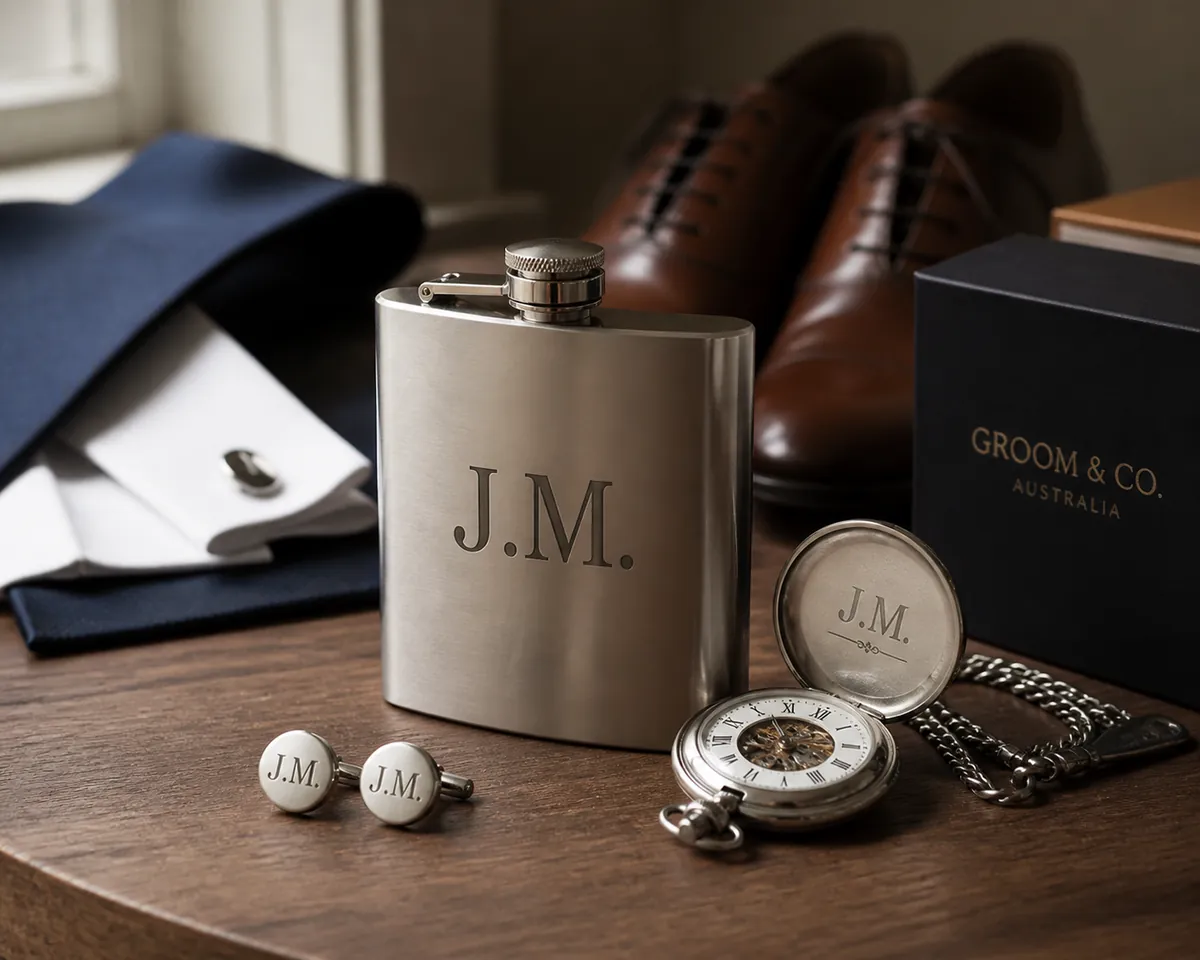
If engraving is part of the plan, both movement types take engraving equally well on the caseback, so that decision doesn’t need to influence movement choice. What does matter is checking the caseback material and thickness before ordering a full set, since some cases engrave more cleanly than others.
See grouped and single-gift options on the skeleton pocket watch range, and read our blog for engraving and personalisation notes specific to pocket watches.
Wearing a pocket watch on the day
Whichever movement you land on, the watch needs to actually work with the outfit. A pocket watch sits in a waistcoat pocket on a chain that clips to a buttonhole or a belt loop, and its job on the day is largely photographic — most grooms and groomsmen check the time on their phones anyway. That means visual weight and chain length matter as much as what’s ticking inside.
Mechanical cases tend to run slightly thicker because they house more moving parts, which can make them sit a touch more prominently against a fitted waistcoat. Quartz cases are often slimmer, which some grooomsmen prefer under closer-cut suits. Neither is wrong, but it’s worth trying the case against the actual waistcoat before the day rather than assuming it’ll sit flat.
Chain style is where a lot of the visual personality comes from regardless of movement — a double Albert chain reads more traditional, a simple bar chain reads cleaner and more modern. Pairing the watch with cufflinks or a tie bar in a matching metal finish (gold with gold, silver with silver) pulls the whole look together far more than the movement type ever will in a photograph.
Explore chain and finish pairings across the pocket watch range, and check the homepage for current gift-set bundles that already pair watches with cufflinks and chains.
Esquire and Brides both cover how small metal accessories should coordinate rather than compete on wedding day.
A buying checklist before you order
Before placing an order, run through a short list rather than deciding on looks alone:
Movement fit: mechanical for a groom who’ll wear and maintain it long-term, quartz for a group gift or a low-maintenance recipient.
Timeline to the wedding: mechanical pieces sometimes need a pre-wear check or regulation before the big day; quartz needs almost none.
Batch consistency: if you’re ordering several at once, confirm the seller can match case finish and chain style across the full set.
Engraving lead time: personalised casebacks take extra production days — order earlier than you think you need to.
Presentation: a proper box or pouch matters more than people expect, especially for gifts handed over on the morning of the wedding rather than mailed.
Budget spread: decide up front whether every groomsman gets the same movement type or whether the groom’s watch is meant to be a step above the rest.
Run through current stock and bundle pricing on the skeleton pocket watch range, and use our blog for a fuller engraving and presentation checklist before you finalise an order.

Advice worth following
People who’ve bought, worn, or restored a lot of pocket watches tend to repeat the same handful of points, and they’re worth taking seriously. Decide on purpose before price — a watch bought purely because it was cheap or because it looked good in a thumbnail is the one most likely to sit in a drawer after the wedding. Decide on purpose first, then let that decision guide the budget.
Test the winding action or the second hand sweep in person or on video before buying a mechanical piece, since a stiff crown or an uneven sweep can be a sign of a lower-quality movement. For quartz, there’s less to inspect mechanically, so spend that attention on case finish and dial legibility instead — those are the two things that will actually show up in photos.
Resist the urge to buy the rarest or most expensive piece for a first pocket watch, mechanical or quartz. A well-chosen, mid-range piece that the groom actually enjoys wearing beats an expensive piece bought to impress rather than to use. If this is the start of an ongoing interest rather than a one-off wedding purchase, later pieces can afford to get more ambitious once personal taste is clearer.
Finally, keep the receipt and any warranty paperwork somewhere the groom will actually find it later. Mechanical watches in particular benefit from being serviced on schedule, and a warranty or service record makes that far easier down the track.
Review current mechanical and quartz picks on our pocket watch range, or start from the homepage if you’d rather browse the full range before narrowing down.
FAQ
Is a mechanical or quartz pocket watch better for a wedding party?
For a group of groomsmen, quartz is usually the safer choice because it needs no winding and holds up to being worn only once a year. For the groom’s own watch, mechanical is often preferred because it becomes a long-term keepsake tied to the day.
Do mechanical pocket watches need regular servicing?
Yes, most mechanical movements benefit from a professional service every few years to keep the gear train and escapement running accurately. Quartz watches only need an occasional battery replacement.
Can I mix mechanical and quartz watches across the group?
You can, and a common approach is quartz for the groomsmen and one mechanical piece for the groom. Just make sure case finish and chain style stay visually consistent across the group for wedding photos.
Does engraving work the same on both movement types?
Yes, engraving is applied to the caseback and isn’t affected by what’s happening inside the watch, so both mechanical and quartz pieces take personalisation equally well.