
Choosing a Stainless Steel Hip Flask for a Groomsman Gift
Stainless Steel Hip Flasks
What Makes Stainless Steel the Right Choice

Ask any groomsman what he actually kept from a wedding weekend, and there’s a decent chance it’s the flask, not the tie or the cufflinks. Part of that comes down to material. Stainless steel is the standard for a hip flask because it shrugs off the everyday knocks a gift like this will take — jacket pockets, glove boxes, the bottom of an overnight bag — without pitting, staining or losing its shape.
Australian conditions add another layer to that. Between humidity on the coast and dry heat inland, a flask needs to hold up in a travel bag for months at a time without any fuss. Stainless steel copes with that kind of neglect far better than pewter or plated alternatives, which is exactly why it’s the material you’ll find behind almost every well-reviewed flask on the market.
There’s also the question of how it looks over time. A cheap metal will dull, discolour or develop a slightly tinny appearance after a year or two of use. Stainless steel keeps its character — whether that’s a mirror polish, a brushed matte, or a leather wrap over a steel body — long after the day it was given.
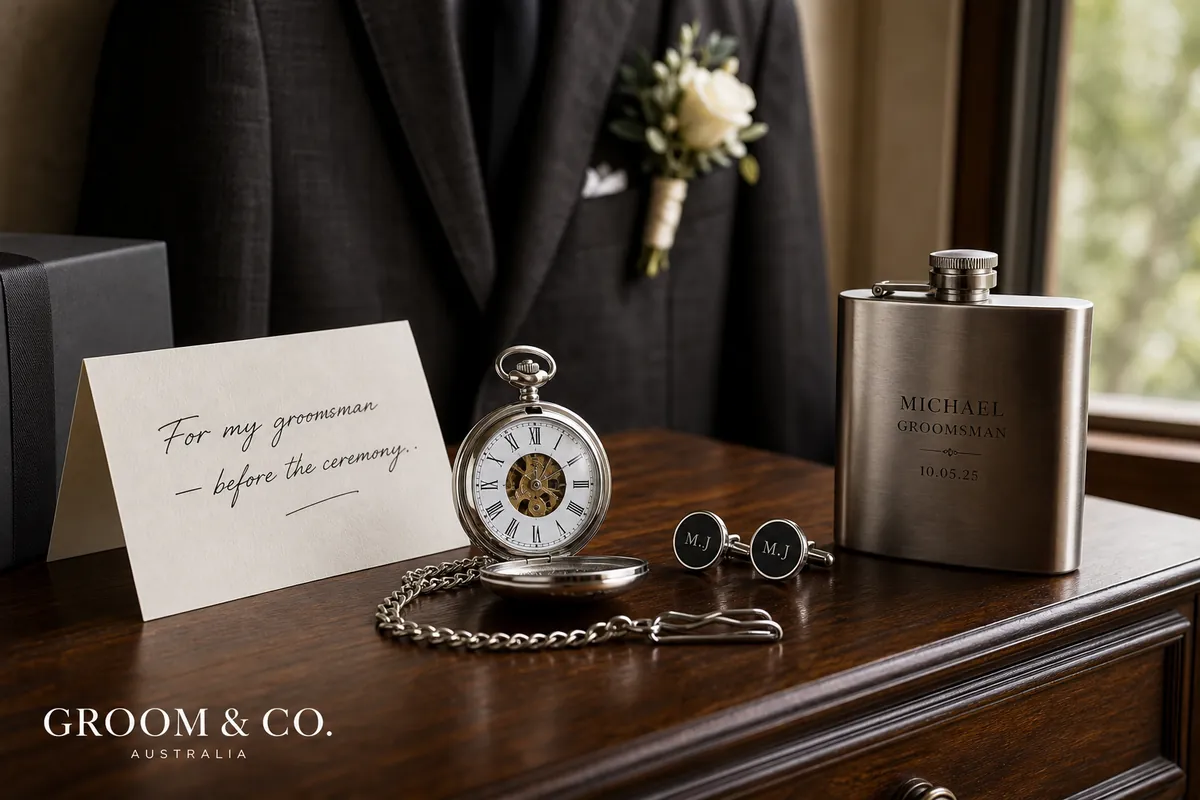
It sits comfortably alongside other groomsman staples too. Pocket watches, cufflinks and flasks all draw on the same appeal: objects that look considered rather than convenient. A steel flask fits that bracket because it reads as something chosen deliberately, not grabbed off a shelf on the way to the bucks party.
If you’re comparing options before deciding, start on the Groom & Co homepage and work through the hip flask range. The about us page is worth a quick read too if you want a sense of who’s behind the range before you commit to a style.
For a sense of how gift-giving culture around weddings has shifted toward more personal, lasting items, both Brides and The Knot cover the trend in more detail.
Picking the Right Flask for the Occasion
Not every flask needs to do the same job. A flask you’re buying for yourself to carry on hikes is a different brief to one you’re handing a groomsman on the morning of a wedding, and it helps to be honest about which situation you’re actually shopping for.
Capacity is the first fork in the road. A 6oz flask sits flat against a jacket without printing through the fabric, which makes it the safer pick for formalwear. Anything closer to 8oz or beyond starts to feel bulkier in a pocket but suits someone who wants a flask that gets used regularly rather than kept as a keepsake.
Finish changes the tone of the gift almost as much as size does. A mirror-polished flask photographs beautifully and suits a formal wedding party. A brushed or matte finish hides fingerprints better and leans more casual, which can suit a milestone birthday or a retirement gift better than a wedding. Leather-wrapped versions split the difference — they feel warmer in the hand and forgive the odd scuff that a bare steel surface would show immediately.
Then there’s personalisation, which is often the detail that decides whether a flask gets used for a decade or forgotten in a drawer within a year. A groom’s initials, a wedding date, or a short line from the best man’s speech engraved on the base turns a generic object into something that’s unmistakably tied to one day. Keep the engraving short — a cluttered inscription reads worse over time than a clean, restrained one.
The groomsmen gift collection is the fastest way to compare sizes and finishes side by side, and our blog has more detailed breakdowns if you want to think through the occasion before you buy. The homepage is a good starting point if you’re not sure where to look first.
On the styling side, GQ and Esquire both have useful reference points for how classic accessories read across different levels of formality.
Keeping Your Flask in Top Condition

Looking after a stainless steel flask is closer to looking after a good knife than a piece of jewellery — it wants to be rinsed, dried, and left alone, rather than fussed over. That simplicity is part of why the material suits a gift that might not get opened again until the next wedding season rolls around.
After each use, a rinse with warm water and a drop of mild dish soap handles almost everything. Spirits leave very little residue behind compared with anything carbonated or sugary, so a flask used mainly for whisky or bourbon needs less attention than one that’s occasionally filled with a liqueur or mixer. Let it air dry fully with the cap off before sealing it back up — trapped moisture is the main cause of any musty smell developing inside.
Every few months, or before it goes back into a gift box for storage, a deeper clean is worth doing. A capful of white vinegar or bicarbonate of soda mixed with warm water, swirled around and left to sit for ten minutes, lifts anything a quick rinse misses. Avoid steel wool or anything abrasive on the outside — it will scratch a polished finish permanently and dull a brushed one unevenly.
Storage matters more than most people expect. A flask rattling around loose in a drawer will pick up scuffs from keys, coins and other hard edges within weeks. If it came with a pouch or a presentation box, that’s where it belongs between uses — not just for the day it’s stored, but for the years after.
The hip flask range and our blog both cover care in more detail if you’re buying a flask that’s likely to see regular use. The about us page is there too if you want the short version of the brand story before deciding.
Broader accessory-care guidance from Vogue and Martha Stewart Weddings covers similar ground for other groomsman staples.
How to Spot a Well-Made Flask
Weight is usually the first tell. Pick up two flasks of the same size and the better-made one will almost always feel heavier, because it’s using a thicker gauge of steel rather than cutting costs on material to hit a lower price point. That extra weight is also what stops a flask feeling hollow or tinny when you tap it.
Look closely at the seam where the two halves of the body are welded together. On a well-made flask, that seam is smooth enough that you can barely feel it under a thumb. On a cheaper one, it’s often a visible ridge or an uneven line — a small detail, but one that tends to predict how the rest of the piece was put together.
The cap deserves its own check. It should screw on with a bit of resistance and sit flush without wobbling once it’s tightened. A cap that spins loosely or doesn’t seat properly is one of the most common failure points on lower-quality flasks, and it’s usually the first thing to fail after regular use.
Finish consistency is the last giveaway. A polished flask should catch light evenly across the whole surface, with no cloudy patches or scratches from the factory. A brushed finish should have a uniform grain running in one direction rather than a patchy, randomly textured surface. If a flask looks slightly different in every photo on a listing, that’s often a sign the finish isn’t consistent piece to piece.
Presentation ties all of this together. A flask that arrives in a fitted box, wrapped properly, with clean engraving if you’ve ordered it, reads as a considered purchase rather than an impulse buy — and that impression carries through to whoever receives it.
Compare finishes directly on the groomsmen gift collection, or read through our blog for more on what separates a well-made flask from an average one. The homepage is the best overview if you’d rather browse the full range first.
GQ and Esquire both touch on how finish and construction separate premium accessories from disposable ones.
Common Mistakes to Steer Clear Of
Novelty shapes are the easiest trap to fall into. A flask moulded like a pistol, a book, or a boot might get a laugh when it’s unwrapped, but it rarely gets used past the first weekend, and it almost never gets kept. If the goal is a gift that survives past the wedding photos, a straightforward rectangular or hip-curved flask will outlast anything designed purely as a gag.
Over-decorating is a quieter version of the same problem. A flask covered in busy engraving, multiple fonts, or an oversized logo tends to look dated within a few years, while a single clean line — a name, a date, initials — stays wearable indefinitely. Restraint tends to age better than anything trying too hard to stand out.
It’s also worth checking capacity against realistic use before ordering in bulk for a wedding party. A flask that’s too large for a suit pocket will end up left behind rather than carried, which defeats the purpose of buying one in the first place. Sizing down slightly is usually the safer call for formalwear.
Skipping the box or pouch is a mistake that shows up later rather than immediately. A flask handed over loose might look fine on the day, but without proper storage it picks up scratches fast, and a scratched flask stops feeling like a keepsake fairly quickly.
Lastly, don’t assume every groomsman wants the same finish. Someone who wears a watch daily and dresses formally most weeks will likely prefer polished steel; someone more outdoorsy might get more use from a matte or leather-wrapped option. A quick read on the person tends to matter more than picking whatever’s most popular.
The our blog and the hip flask range are worth checking before ordering for a full wedding party, and the about us page gives a fast overview of the brand if you’re comparing suppliers.
Brides and The Knot both flag similar pitfalls around groomsmen gifting more broadly.

Making the Gift Feel Complete
How a flask is handed over matters almost as much as the flask itself. A groomsman opening a plain flask pulled from a shopping bag registers it differently to one opening a fitted box with his initials on the base — the object is identical, but the moment isn’t, and that moment is what people remember.
A presentation box does two jobs at once. It makes the unwrapping feel deliberate, and it gives the flask somewhere to live afterward, which noticeably extends how well it holds its finish over time. If engraving is on the table, keep it to something that will still make sense in ten years — a name and a date outlasts an inside joke that might not land the same way later on.
Timing the handover helps too. Groomsmen gifts landing the morning of the wedding, alongside a short note or a few words from the groom, tend to carry more weight than the same gift given weeks earlier at a casual dinner. The context of the day does a lot of the emotional work the object alone can’t.
If you’re putting together a broader gift set rather than a single flask, pairing it with something like a pocket watch or a set of cufflinks can round the presentation out without overcomplicating it. Two well-chosen pieces usually read better than four mismatched ones, so it’s worth resisting the urge to pad the box out for its own sake.
Browse full sets and individual pieces through our groomsmen gift collection, or check our blog for more on building a gift box that suits the wedding party. The homepage and about us page are both good starting points if you’re shopping for a group rather than one person.
Vogue and Harper’s Bazaar both cover how presentation shifts the perceived value of a classic accessory.
Frequently Asked Questions
What size flask should I buy for a groomsman?
A 6oz flask is the safest choice for formalwear because it sits flat in a suit jacket without showing through the fabric. Larger flasks around 8oz suit someone who plans to use it regularly rather than keep it mainly as a keepsake.
Does stainless steel affect the taste of what’s inside?
A well-made stainless steel flask is largely non-reactive and shouldn’t alter flavour if it’s rinsed and dried properly between uses. Any metallic taste usually points to a lower-grade steel or a flask that hasn’t been cleaned after its last fill.
Is engraving worth it for a groomsman gift?
Engraving is usually what turns a flask from a nice object into a kept one. A short, clean line — initials, a date, or a brief thank-you — tends to age far better than a longer or more decorative inscription.
How often does a hip flask actually need cleaning?
A rinse after every use is enough for day-to-day upkeep. A deeper clean with warm water and a little vinegar or bicarbonate of soda every few months keeps the inside fresh, especially before it goes back into storage.