

How Grooms Should Set and Wind a Pocket Watch
How Grooms Should Set and Wind a Pocket Watch
How a Mainspring Actually Keeps Time
Every mechanical pocket watch is built around a tiny piece of physics rather than a battery: a tightly coiled ribbon of spring steel called the mainspring. Turning the crown tightens that coil, and as it slowly unwinds again over the next day or so, it feeds energy through a chain of gears to the balance wheel, the small wheel that oscillates back and forth and divides time into ticks. Stop winding and the coil eventually relaxes completely, the gears stop turning, and the hands simply freeze wherever they last were.
This is a much older piece of engineering than most people realise. Portable spring-driven timekeepers date back to the 15th and 16th centuries, and the same core principle — stored spring tension released at a governed rate — is still what sits inside a new pocket watch today. The Encyclopaedia Britannica has a good overview of how that mechanism evolved from early spring-driven clocks into the pocket and wristwatches we recognise now.[1]
If you’ve just unboxed something from our pocket watch collection, give it a complete wind before wearing it for the first time. A watch that’s been sitting unworn has a fully relaxed spring, and running it on a half-hearted wind for its first few hours can make the balance wheel tick unevenly until you give it a proper full charge.
Setting the Time Before You Wind
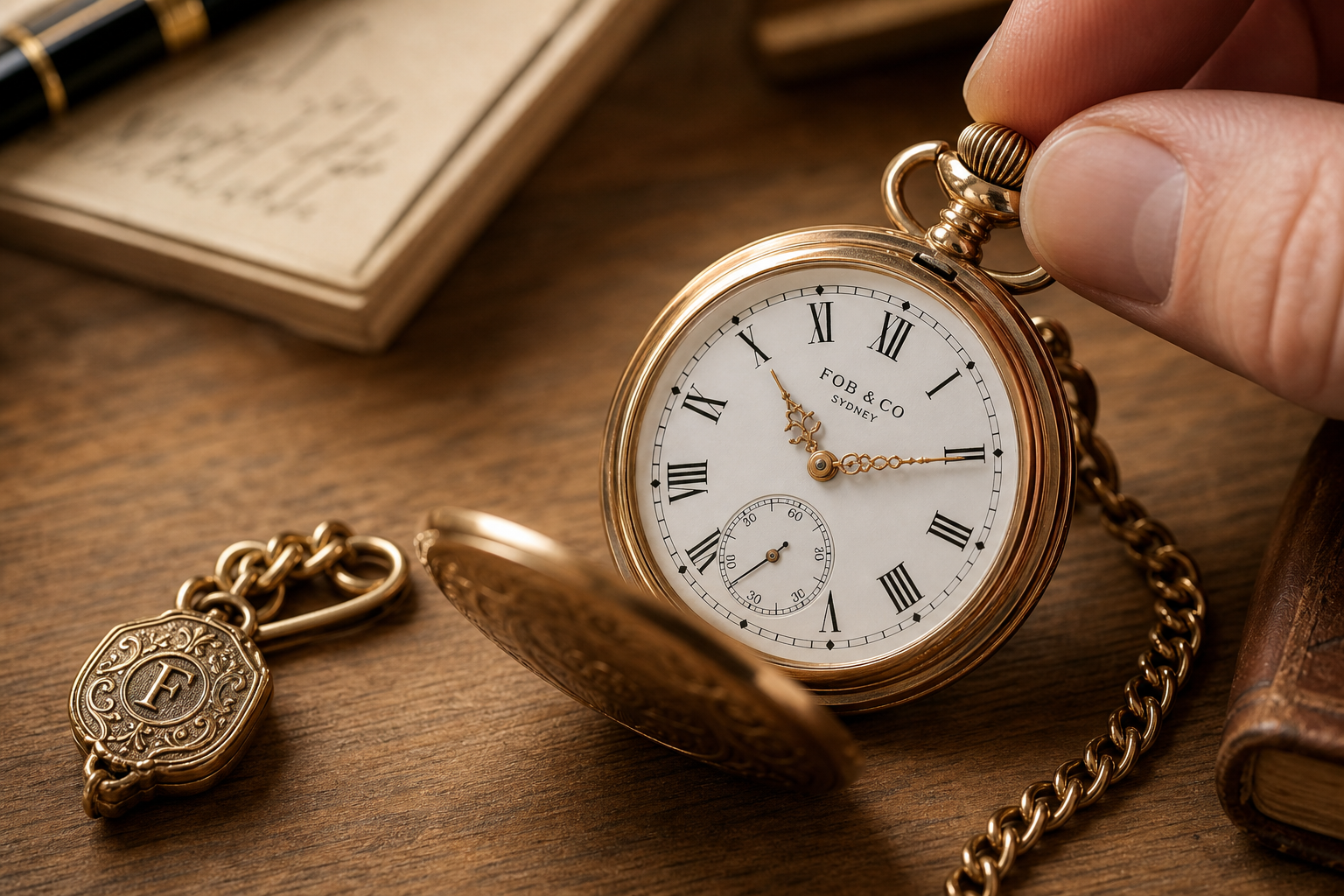
People often reach for the crown and start winding straight away, but it’s worth setting the time first so you’re not fighting the hands later. Pull the crown outward and, on almost every stem-set pocket watch, you’ll feel a single click as it shifts from winding mode into setting mode. Turn it in either direction until the hands sit where you want them, then push the crown firmly back in until it sits flush against the case. That returns it to winding mode.
Older and antique pieces sometimes use lever setting instead of a pull-out crown. If you’ve picked up a secondhand or inherited piece and the crown spins but the hands won’t budge, open the case back and look for a small lever near the movement — flipping it usually engages the setting function. It’s worth checking that before assuming the watch needs a repair.
One habit worth building: try to avoid dragging the hands backwards through a large gap, and avoid setting through the window roughly between 9pm and 3am on the dial. Many movements run a date-change mechanism during those hours, and pushing the hands through it under force can bend the switching gear. If the time is a long way off, wind the hands forward through a full 24-hour turn instead of jumping the other way.
Winding the Crown Step by Step
With the crown pushed back in against the case, hold the watch in one palm and turn the crown clockwise using your thumb and forefinger — small, even turns rather than one continuous spin. Counterclockwise turns on most modern stem-wind movements just spin freely because the internal ratchet only catches one way, so don’t worry if it feels like nothing is happening when you turn it the other direction.
Keep turning and you’ll feel the resistance climb gradually. Somewhere between 15 and 25 turns on most calibres, that resistance firms right up and the crown stops wanting to move any further. That’s the mainspring fully wound, and it’s your signal to stop, not a wall to push through. Forcing the crown past that point is the single most common way people damage the winding mechanism on an otherwise perfectly good watch.
A practical trick many collectors use: wind the watch off your wrist or waistcoat, resting it in your palm, rather than while it’s still clipped to a chain. You get a cleaner, more controlled grip on the crown that way, and there’s less chance of twisting the stem sideways by accident.
Case Styles Change How You Wind
The winding action itself barely changes across styles, but how easily you can reach the crown, and how careful you need to be, depends a lot on the case.
Open Face Cases
With nothing covering the dial, the crown sits right at 12 o’clock and there’s no cover to catch it on. This is the most straightforward style to live with day to day, and a sensible starting point if you’re new to mechanical watches.
Full Hunter and Half Hunter Cases
A hinged lid protects the dial and pops open when the crown is pressed inward rather than turned. That means winding a hunter case takes a slightly firmer, more deliberate rotation so you don’t accidentally spring the lid open mid-wind. Our full hunter pocket watches make the distinction between the two actions fairly obvious once you’ve handled one a few times, but it pays to practise before you’re wearing one at a ceremony.
Traditional Key-Wind Pieces
Rarer today, but still found in antiques and some reproduction designs, these use a separate key that fits over a square arbor rather than a built-in crown. If that older mechanism appeals to you, our classique pocket watch range carries pieces with that vintage character while still using a modern, more forgiving stem-wind movement underneath.
Brass and Gold Cases
The case material has no bearing on how you wind the watch — a brass pocket watch or a gold pocket watch uses the same stem-wind action as any other piece; the metal only changes the look and the way the case ages over time.
Choosing a Pocket Watch as a Gift
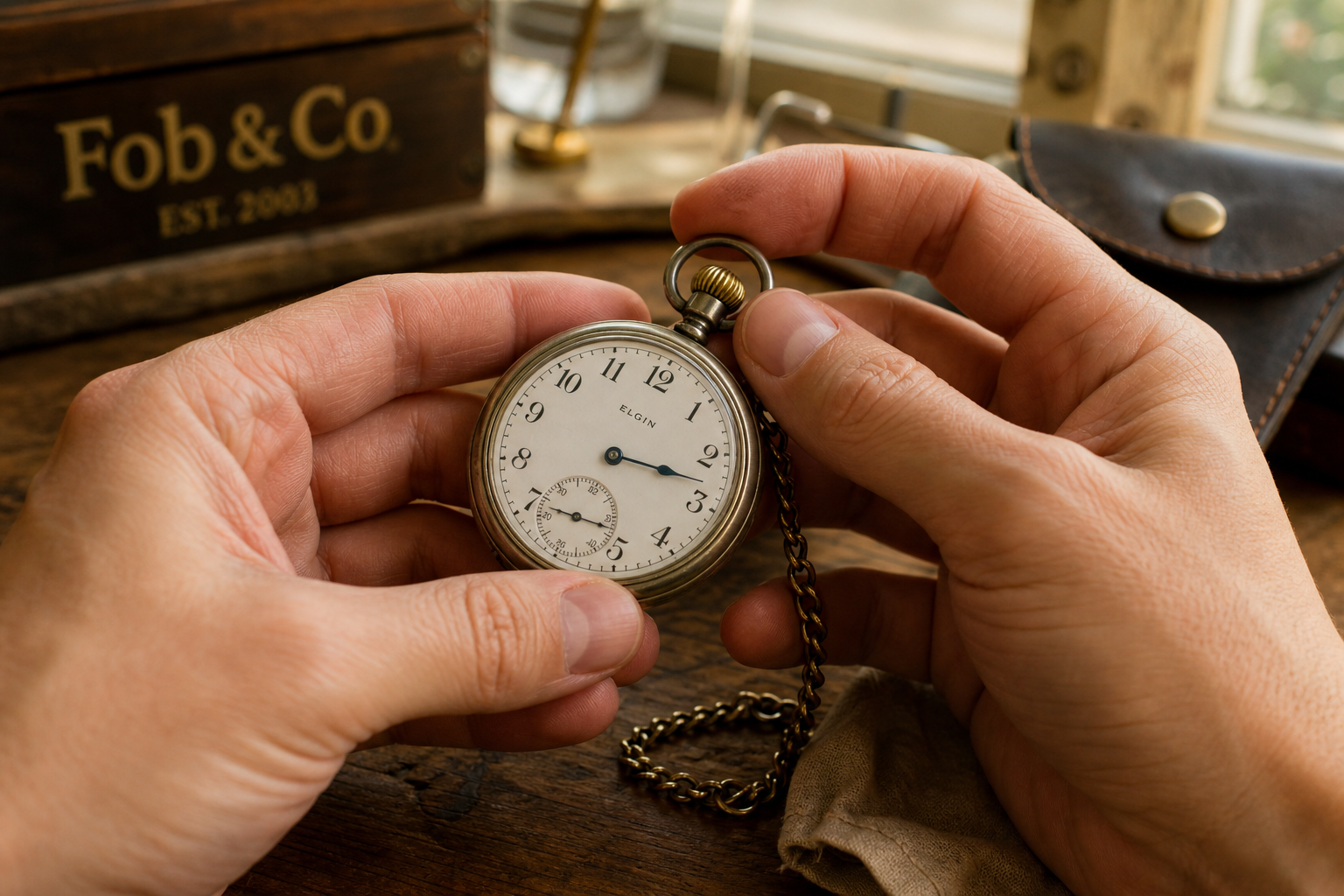
Pocket watches turn up regularly as groomsmen presents, best man gifts, and retirement or graduation keepsakes, and buying one for someone else means thinking about a few things beyond the dial design.
How long it runs on a full wind. Entry-level movements often manage 24 to 30 hours, which means the recipient needs to wind at close to the same time every day or risk it stopping overnight. A movement rated closer to 36 or 40 hours gives a bit more forgiveness if a night gets missed.
Crown feel. If you’re buying for someone older or with reduced grip strength, a wider, more textured crown is genuinely easier to turn than a small, smooth one. Check close-up product photos, or handle a floor sample if you can, before buying online.
Whether it will be engraved. If this is a groomsman or best man gift, get engraving sorted before the watch goes into daily rotation. Our engravable pocket watches have a smooth, purpose-built case back for exactly this, and it’s far simpler to organise before the recipient starts winding and carrying it every day.
Gold and formal finishes. For weddings or other dressed-up occasions, our gold pocket watches often have finer, more delicate crowns than a rugged field-style piece, so they reward a lighter touch and shorter turns rather than firm cranking.
A chain or fob. A pocket watch on its own has nothing to attach it to a waistcoat or belt loop, so it’s worth browsing our accessories range for a matching chain, fob, or travel case at the same time.
Budget. If the goal is a genuine mechanical movement without paying full retail, our clearance range is worth checking first — stock changes regularly, but a clearance piece winds and sets exactly the same way as anything at full price.
Non-formal wear. Not every recipient wants a waistcoat-and-chain style watch. For someone in a clinical or shift-based role, our nurses watches apply the same stem-wind mechanics in a clip-on, fob-style format built for a working day rather than a wedding.
Mistakes That Wear Out a Movement
Almost every winding problem we hear about comes down to one of a handful of habits. Cranking the crown with real force once it’s already gone firm is the biggest one — the spring is fully wound at that point, and continuing to push only strains the winding stem and the click spring behind it. Winding irregularly is another: letting the watch run down completely every few days and then giving it a big catch-up wind puts more strain on the mechanism than a shorter, daily top-up would.
Setting the time by yanking the hands backwards across long distances, rather than running them forward, is also a common source of avoidable damage, particularly on watches with a date function. And winding or setting while the watch is still on a swinging chain, rather than steadied in your palm, makes it easier to twist the stem at an angle it isn’t designed for.
Daily Habits That Add Years of Life
Wind at a fixed point in the day — first thing in the morning is easy to remember — so the mainspring tension stays roughly consistent and timekeeping stays steady. Keep the watch away from mobile phone speakers, laptop edges, and magnetic clasps, since a magnetised balance wheel can start running fast or slow until it’s demagnetised, even though it keeps ticking the whole time.
Every three to five years, have the movement serviced by a qualified watchmaker. Even with careful winding habits, the internal lubricants dry out gradually, and a proper service catches wear before it turns into an expensive repair. Groups such as the American Watchmakers-Clockmakers Institute maintain directories of accredited watchmakers if you need to find someone qualified to service an older or antique piece.[3] Collector organisations like the National Association of Watch and Clock Collectors are also a solid resource if you want to go deeper into the history and mechanics of a specific movement.[2]
Frequently Asked Questions
How many times should you turn the crown to fully wind a pocket watch?
Most pocket watch movements take somewhere between 15 and 25 turns to reach a full wind, though this varies by calibre. Turn steadily and stop the moment you feel firm resistance rather than counting turns and stopping partway.
Can you damage a pocket watch by winding it too much?
Gentle turning won’t overtighten a modern mainspring in a way that snaps it, but forcing the crown past its natural stopping point can strip the winding mechanism itself. The rule is simple: stop as soon as the resistance goes firm.
What’s the difference between winding an open face and a hunter case?
Mechanically, nothing — both use the same crown and the same clockwise turning motion. The practical difference is that a hunter case crown also opens the hinged cover, so you need a slightly firmer, more deliberate turn to wind it without accidentally popping the lid.
Is a mechanical pocket watch a good groomsman gift?
It’s one of the more practical keepsakes precisely because it needs a small daily ritual to keep running, which tends to make it more personal than something worn once. Pairing it with engraving and a matching chain makes it feel complete as a gift rather than just a novelty.
How often should a mechanical pocket watch be serviced?
Roughly every three to five years, even if it’s been winding and keeping time without issue. Internal lubricants dry out gradually regardless of how carefully the watch has been used, and a routine service catches small wear before it becomes a larger repair.


