

Caring for an Engraved Pocket Watch Gift in Australian Conditions
TL;DR
A pocket watch bought or gifted in Australia has to survive conditions few timepieces were engineered for: tropical humidity, outback heat spikes, salt-laden coastal air and fine red dust. None of that means the watch is fragile — it means the owner needs a slightly different maintenance rhythm than a guide written for a European climate would suggest. Sensible storage, a wipe-down after wear, and a servicing interval pulled forward by a year or two are usually enough to keep a groomsman’s fob watch or a family heirloom ticking for the next several decades.
Pocket Watch Care Guide for Australia’s Harsh Climate
Table of Contents
- The Climate Problem Nobody Warns You About
- Quartz or Mechanical? Matching Care to Movement Type
- Everyday Habits That Protect the Movement
- Storing a Pocket Watch, Region by Region
- Cleaning a Pocket Watch Without Causing Damage
- Building a Sensible Service Schedule
- On the Road: Utes, FIFO Kit and Beach Trips
- From Gift Box to Display Stand
- FAQ
- References
A groomsman opens a small box on the morning of the wedding and finds a pocket watch waiting inside — the kind of gift that’s meant to still be running when he’s walking his own daughter down the aisle years later. Getting a watch to last that long anywhere is a matter of good habits. Getting one to last that long in Australia is a slightly different exercise, because our weather does things to metal, oil and glass that a manual written in Switzerland or England never anticipated. This guide walks through what actually happens to a pocket watch in Australian conditions and what to do about it, whether the piece is a brand-new gift or a watch that’s been sitting in a drawer since your grandfather’s time.
The Climate Problem Nobody Warns You About
Four things set Australia apart from the climates most pocket watches are designed in: sustained coastal humidity, inland heat that regularly tips past 40°C, some of the highest UV exposure recorded anywhere, and airborne dust fine enough to work its way past a case seal. Together they shorten the intervals a watch can safely go between cleaning and servicing.
Most pocket watch movements, whether Swiss quartz calibres or hand-finished mechanical ones, were developed for markets where a hot day means 28°C and humidity swings gently between seasons. Australia doesn’t play by those rules. A watch pocketed on a Brisbane summer afternoon or left in a Kalgoorlie hotel room is under a different kind of load than the same watch sitting in a London drawer, and the wear shows up as oils that thin out early, seals that harden and crack, and dials that lose their crispness under UV.
Four stressors do most of the damage:
- Salt-laden humidity along the coast: Speeds up oxidation on brass, steel and silver-plated cases. Moisture doesn’t need an open case back to get in — a worn gasket or a loose crown is enough of a gap.
- Extreme inland and northern heat: Thins lubricants faster than the textbook 3–5 year service window assumes. A watch left in a car console or a backpack in direct sun can sit above 60–70°C for hours, which no lubricant is designed to handle.
- Some of the world’s highest UV levels: Bleaches dial colour, brittles rubber gaskets and can dull certain case finishes over a few summers of regular sun exposure.
- Fine dust, particularly inland: Works into hinge lines and crown threads and behaves like a mild abrasive against moving parts once it reaches the movement.
The Australian Government’s National Archives publishes storage standards for exactly this reason — metal and mechanical objects in its own collections need tighter humidity and temperature control here than equivalent items would in a European archive, and the same physics applies to a watch in a drawer at home.
Quartz or Mechanical? Matching Care to Movement Type
A quartz pocket watch has a sealed, battery-driven circuit with almost nothing to lubricate, so heat and dust bother it far less. A mechanical or automatic movement runs on an oiled train of gears and a coiled mainspring, and Australian heat ages that oil noticeably faster than the manufacturer’s default service interval expects.
Quartz Movements
A quartz movement keeps time from a battery-driven oscillating crystal rather than a wound spring, which is part of why Groom & Co’s Classique Swiss pocket watch collection holds accuracy so reliably with so little fuss. For an Australian owner, three things matter most:
- Swap the battery roughly every 12–24 months rather than letting it run flat, since a spent battery can leak and corrode the movement
- Push or screw the crown fully home after setting the time, since that’s what maintains whatever moisture resistance the case has
- Keep it out of direct sun when it’s not being worn, since UV still affects the dial finish even on a quartz piece
Mechanical and Automatic Movements
A mechanical pocket watch — including the hand-finished calibres inside Groom & Co’s own skeleton pocket watches — stores energy in a coiled mainspring and releases it through a train of tiny, precisely fitted gears. Those gears need oil to run smoothly, and heat is the enemy of watch oil specifically. A movement serviced every five years in a UK climate is a reasonable ask for its owner there; the same watch living through Australian summers is better served by a three-year cycle, since the lubricant is ageing under harsher conditions the whole time in between.
A mechanical watch running on tired oil doesn’t necessarily stop — it keeps going while pivots, jewels and the escapement wear down faster than they should, which is a quieter and more expensive problem than a watch that simply won’t wind.
Everyday Habits That Protect the Movement
Small, repeated habits do more for a pocket watch than any single deep clean: dry hands before handling, a quick wipe after wear, winding at the same time each day, keeping the piece away from magnets and letting it acclimatise gradually between air-conditioning and outdoor heat.
- Handle it with dry hands. Sweat is mildly acidic and reacts with brass and silver over time — a bigger factor during an Australian summer or at an outdoor wedding than it would be in a cooler climate.
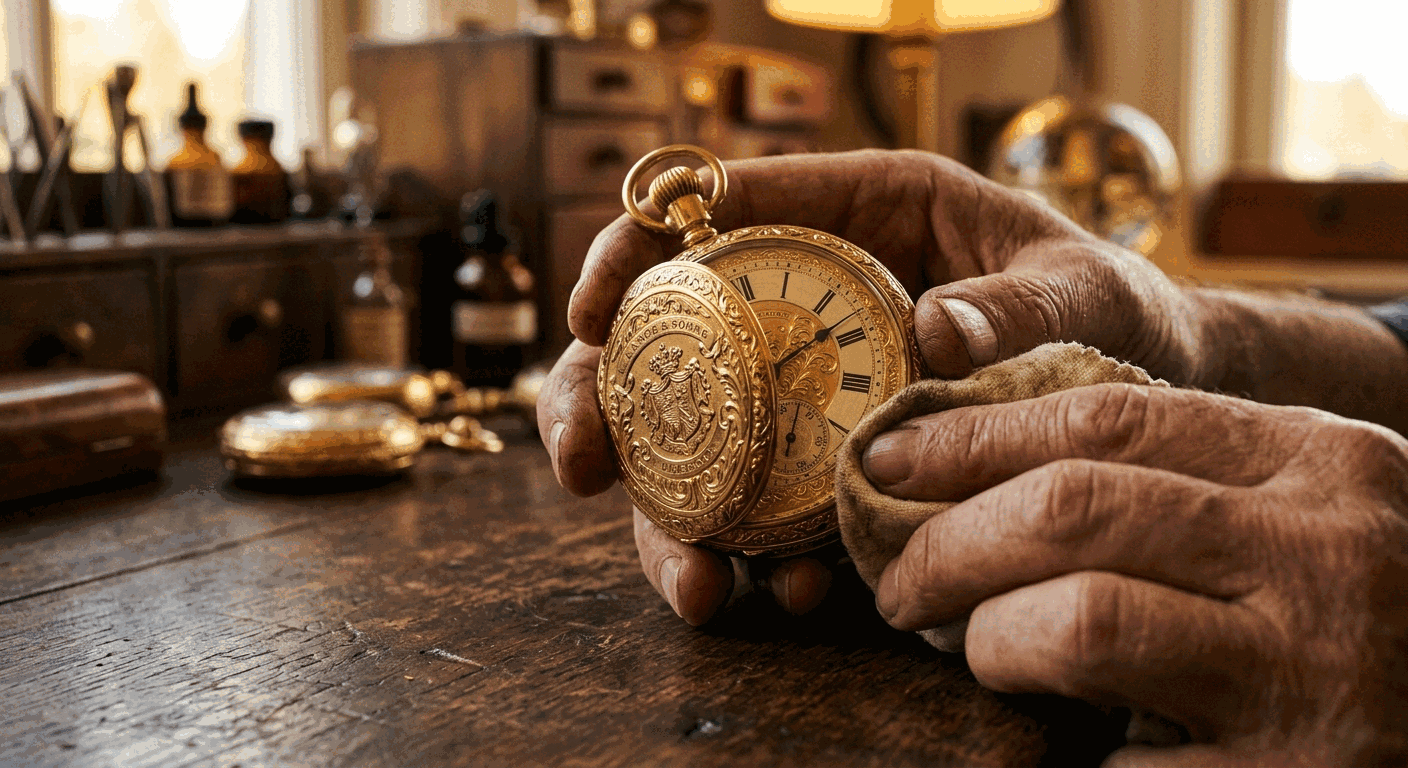
- Wipe it down after wear. A soft microfibre cloth run over the case and chain takes a few seconds and clears sweat, dust and fingerprints before they sit long enough to mark the finish.
- Wind at a consistent time. Hand-wound movements do better with a regular routine — wind gently each morning or evening and stop the moment you feel resistance, rather than forcing the crown further.
- Keep it clear of magnets. Phone speakers, magnetic bag clasps and laptop lids can all magnetise steel components in a mechanical movement, throwing off its timekeeping until it’s demagnetised.
- Let it acclimatise. Moving straight from an air-conditioned car or office into Australian outdoor heat can condense moisture inside the case. Give the watch a few minutes to adjust where you can, rather than exposing it to a sudden swing.
Storing a Pocket Watch, Region by Region
Aim for storage somewhere between 15–25°C with roughly 40–50% relative humidity, out of direct sunlight. What that looks like in practice depends heavily on which part of Australia you’re in, since a Cairns bedroom and an Alice Springs shed present very different problems.
How a watch is stored between wearings probably matters more than any other single factor in this guide. A watch left in a hot glovebox, on a sun-facing windowsill, or in a steamy bathroom cabinet is quietly ageing every single day it sits there, long before anyone notices a problem with the timekeeping.
Storage Approach by Climate Zone
- Tropical north (Far North Queensland, the NT, WA’s north coast): Humidity is the dominant threat. Drop a silica gel sachet into the watch box and replace it every couple of months, and consider a sealed display case if the piece is kept out on show.
- South-eastern coastal cities (Sydney, Melbourne, Adelaide, Brisbane): Salt air and moderate humidity call for storing the watch indoors rather than on an open shelf near a window or verandah. A padded watch box adds cushioning as well as a small buffer against humidity swings.
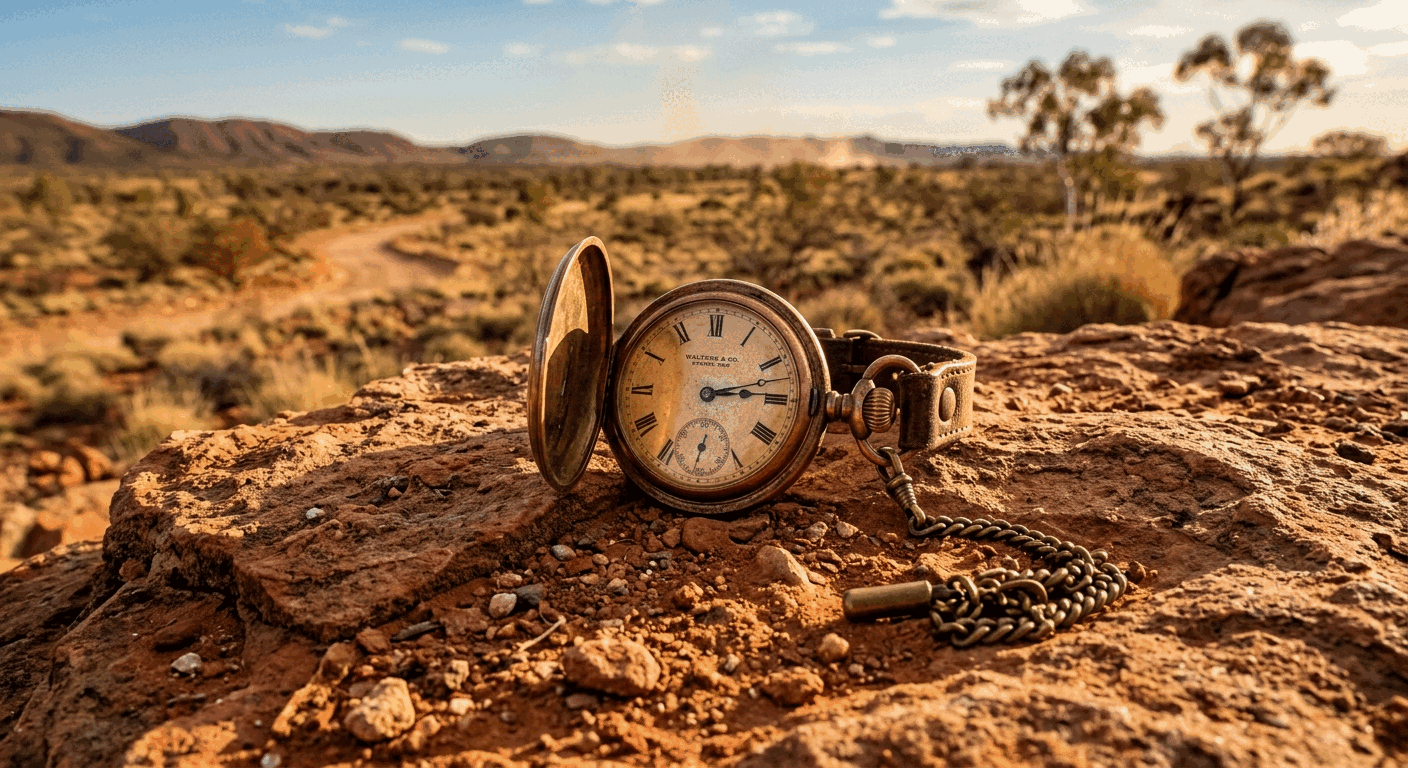
- Dry inland and outback regions: Heat and UV do the most damage here. Avoid direct sunlight entirely, and store the watch in an interior drawer or cabinet away from exterior walls, which absorb and hold heat through the day.
Anywhere in the country, avoid rooms that swing hard between temperatures — garages, sheds and sunrooms are all poor choices, while a bedroom or study with steady air conditioning is close to ideal.
Cleaning a Pocket Watch Without Causing Damage
Stick to a dry or barely damp soft cloth for the case exterior. Skip spray cleaners, ultrasonic baths and running water unless the watch is explicitly rated for water resistance, and leave anything inside the case to a qualified watchmaker.
Cleaning the Case
Whether the case is silver, gold-tone, brass or a matte black finish, a dry microfibre cloth is the safest first move. For a stubborn mark, dampen the cloth very slightly rather than wetting it, and dry the case immediately afterwards, paying particular attention to hinges, the case-back join and the area around the crown where moisture likes to linger.
Steer clear of:
- Alcohol wipes or hand sanitiser, which strip protective lacquer and dull certain finishes over time
- Silver polish creams applied near joins or hinges, since the residue can migrate into the movement
- Running water or full immersion — pocket watches are not built to be submerged
- Compressed air blasted straight into a case opening, which tends to push dust deeper rather than out
Crystal and Dial
A mineral crystal can be gently buffed with a dry cotton cloth, while an acrylic crystal responds well to a specialist plastic polish for light scratches. Sapphire crystals, common on higher-end pieces, resist scratching far better than either but still deserve a gentle touch rather than firm rubbing.
Chains and Fobs
Albert chains and fob chains pick up the same humidity and perspiration exposure as the watch itself. Wipe them down after wear and store them separately from the case in a soft pouch, which avoids scratching and keeps the chain from tangling with the crown.
Building a Sensible Service Schedule
A mechanical pocket watch generally wants a professional service every 3–5 years, and Australian owners in warmer or coastal areas should lean toward the three-year end of that range. Quartz watches need a fresh battery every 1–2 years and a fuller service roughly every 7–10 years.
A proper service on a mechanical movement means full disassembly, ultrasonic cleaning of every component, a check for worn parts, replacement of seals and gaskets, fresh lubrication and a regulation pass to correct timekeeping. Budget somewhere in the vicinity of $80–$200 depending on the watchmaker and the complexity of the movement — modest money set against a watch that’s either worth considerably more or, in the case of a groomsman’s gift, worth far more sentimentally than its price tag suggests.
Signs It’s Time to See a Watchmaker
- Running more than 2–3 minutes fast or slow across a day
- Stopping unexpectedly despite a full wind
- Fogging or visible condensation under the crystal
- A crown that feels stiff, gritty or uneven to turn
- A case back or hinge that no longer sits flush
- An unfamiliar ticking rhythm or irregular beat
Waiting for a mechanical watch to actually stop before booking a service usually means it’s been running dry for a while already, which turns a routine clean and oil into a repair job. Getting ahead of it with preventive servicing is the cheaper and easier path by a wide margin.
On the Road: Utes, FIFO Kit and Beach Trips
Travelling around Australia — a FIFO swing in the Pilbara, a coastal honeymoon, or a long drive through the outback — throws temperature swings, vibration, humidity and dust at a pocket watch all at once. A hard-sided case and a bit of forward planning cover most of it.
FIFO and Site Work
For workers on FIFO rosters through WA or Queensland, a pocket watch tends to be a keepsake rather than something worn on shift. Leave it in the donga or hotel room rather than in a site bag or locker, where heat spikes and fine mineral dust do the most damage. A compact hard-sided case, or even a zip-lock bag with a silica sachet tucked inside, is a low-effort way to protect it between trips home.
Long Drives
Never leave a pocket watch on a dashboard or in a glovebox during an Australian summer drive — cabin temperatures in direct sun can climb well past 60–70°C, which is more than enough to soften lubricants and fade a dial. If the watch has to travel with you, an insulated bag in the coolest part of the vehicle is a far safer bet.
Beach and Boat Trips
Salt air speeds up corrosion on both the case and the chain noticeably faster than inland humidity does. If a pocket watch comes along on a coastal trip, keep it well away from the water and give it a thorough wipe-down as soon as you’re back, rather than leaving salt residue to sit overnight.
From Gift Box to Display Stand
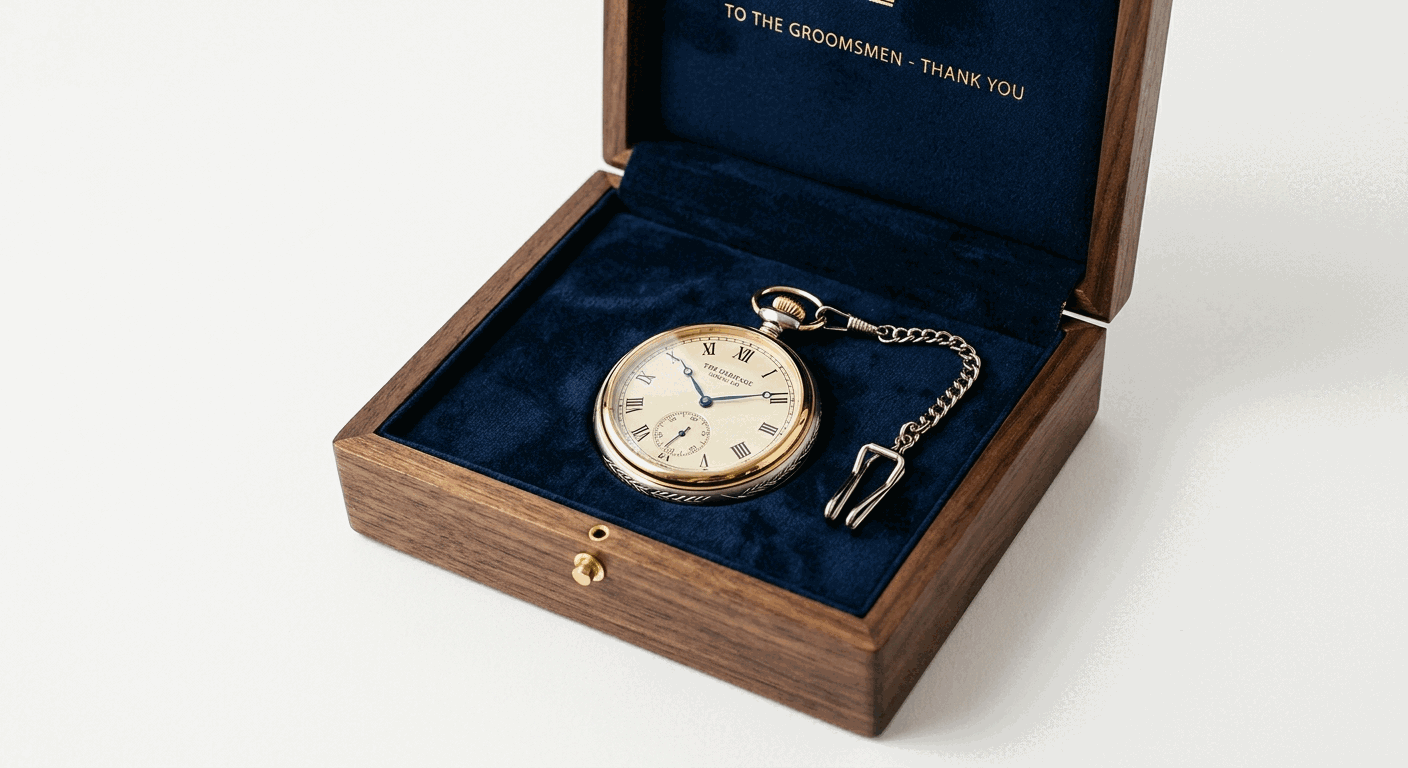
A pocket watch bought as a gift needs the same care thinking baked in from day one — a solid presentation box protects it through the handover and beyond, and a proper stand keeps it safe once it’s out on display rather than tucked in a drawer.
Pocket watches suit milestone gifting particularly well — weddings, retirements, graduations, big birthdays — because they’re built to be handed down rather than replaced. Groom & Co’s engravable pocket watches let you personalise the case back with a name, date or short message, which turns a well-made timepiece into something closer to a family heirloom from the first wear.
For a watch kept on show rather than in a drawer, a pocket watch stand holds it upright and open so the dial and case detail are actually visible, day to day. When positioning a display piece:
- Keep it away from direct window light, since UV fades dials gradually over years
- Choose a room with steady temperature rather than a sunroom or garage
- Avoid resting it on top of speakers or other electronics that can magnetise the movement
If you’re putting together a groomsmen gift set built around pocket watches, a short care card tucked into the box is a nice extra touch — most recipients, especially with a mechanical movement, won’t have owned one before and will appreciate the pointer. It costs nothing and turns a good gift into one that’s still running at the next family wedding.
For anyone starting a collection or after something worth displaying rather than just carrying, the skeleton pocket watch range at Groom & Co shows off the movement itself — a piece that looks as good on a stand as it does in a pocket.
Frequently Asked Questions
How often should a mechanical pocket watch be serviced in Australia?
Every three years is a sensible default for tropical or outback conditions, stretching to four or five years in milder, drier southern climates. A service replaces ageing lubricant, checks for wear on small components, and keeps the movement running to time.
Is it safe to wear a pocket watch to the beach?
Best avoided. Most pocket watches, dress pieces included, carry no meaningful water resistance rating. Salt water, sand and the humidity around the coast can corrode metal parts, fog the crystal and contaminate the movement, so it’s worth leaving the watch stored safely rather than risking it near the water.
What’s the best storage approach in a humid state like Queensland?
A padded box with a silica gel sachet inside handles most of the humidity problem. Keep the box somewhere stable and out of direct sun, and swap the sachet every two to three months in tropical areas, or sooner if it has a colour-change indicator showing saturation.
Does Australian heat affect quartz watches as much as mechanical ones?
Less so, since a quartz movement has far fewer moving parts and needs little to no lubrication. That said, sustained heat above roughly 60°C — a parked car in summer, for instance — can still damage the battery, circuit and dial, so the same storage caution applies either way.
What’s the correct way to clean a pocket watch case?
A dry or very lightly dampened soft microfibre cloth, run over the case, crystal and chain every few wears. Avoid alcohol-based cleaners and abrasive cloths, and never submerge the watch or hold it under running water unless it carries an explicit water resistance rating, which the great majority of pocket watches don’t.
Does engraving weaken the case or affect the movement?
No. Case-back engraving sits on a separate sealed cover and has no bearing on the movement inside, which is why it’s such a popular way to personalise a milestone gift. Groom & Co’s engravable pocket watches are built with this exact use in mind, giving a clean surface for a crisp inscription.
What temperature and humidity suit long-term pocket watch storage?
Somewhere around 15–25°C with 40–50% relative humidity is the sweet spot for long-term storage. Steer clear of garages, sheds and poorly insulated rooms during an Australian summer — steady, moderate conditions are far kinder to watch lubricants and seals than repeated swings between hot and cold.
References & Sources
- National Museum of Australia — How to care for personal adornment and accessories. Conservation guidance for metal artefacts, including timepieces.
- National Archives of Australia — Storing and Preserving Artefacts and Objects. Temperature and humidity standards for metal and mechanical objects under Australian conditions.
- Horological Society of New York — Horological Society of New York. Industry guidance on mechanical watch servicing intervals and lubrication.